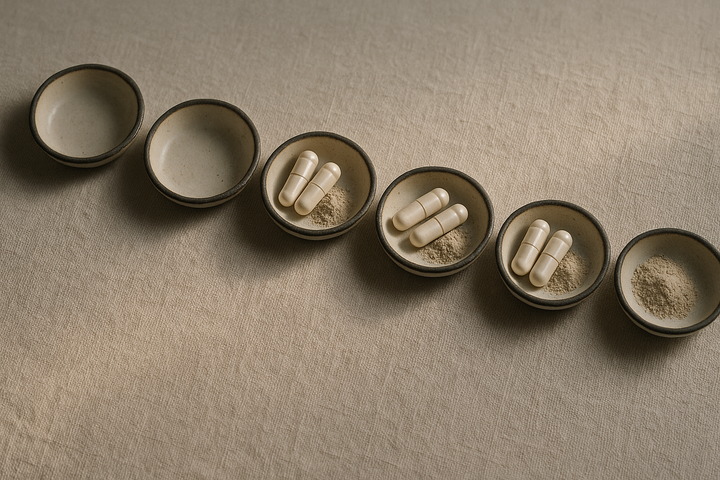
Almost every supplement page you read implies a single number: this much goes in, that much is absorbed. That number does not exist. Absorption is not a property of a capsule the way weight or colour is. It is the result of a measurement, and the result moves with the size of the dose, how depleted you already are, what you ate alongside it, and which method the researchers used. For most minerals the shape of the honest answer is the opposite of the marketing: the more you swallow in one go, the smaller the fraction that crosses into you. And blood, the thing everyone points at, is only a proxy for what your tissues actually received.
The short answer
There is no fixed percentage. For magnesium, measured across a wide range of intakes with a standard meal, the fraction absorbed fell from 65 percent at the lowest intake to 11 percent at the highest [1]. For calcium, fractional absorption fell from 64.0 percent at a small load to 28.6 percent at a 500 mg load [2]. For zinc, modelling of many absorption studies puts the maximum an adult will take up at roughly 6 mg per day, no matter how much more the label promises [3]. Those are not contradictions between studies. They are the same rule: uptake is regulated, and regulation means the percentage falls as the amount rises.
Bioavailability is a measurement, not a property
In medicines, bioavailability has a precise meaning: the rate and extent to which the active substance reaches the systemic circulation, established by measuring a concentration over time curve in real people. Regulators are exact about this because a generic medicine has to prove it behaves like the original [4].
Nutrients are harder. A drug is usually a foreign molecule that the body has no machinery to ration. A mineral is something your body has spent evolution learning to control. Your gut decides how much to let in, your kidneys decide how much to keep, and both decisions depend on how much you already have. That is why a single absorption percentage for a nutrient is almost always a simplification of a curve.

What an absorption study actually measures
Strip a bioavailability study down and it produces three quantities, all of them descriptions of a curve rather than of a benefit. The European Medicines Agency defines them plainly: AUC, the area under the concentration time curve, reflects the extent of exposure; Cmax, the maximum plasma concentration, is the peak exposure; and tmax, the time to that peak, is influenced by the rate of absorption [4].
To call a generic medicine equivalent to the original, the 90 percent confidence interval for the ratio between the two products must fall inside an acceptance interval of 80.00 to 125.00 percent, for AUC and for Cmax [4]. That is a demanding, well defined test, and it is worth knowing exactly what it proves: that two products put a comparable amount of substance into the blood at a comparable speed. It says nothing about whether the substance helped.
That standard belongs to medicines. A supplement label makes a different kind of statement. It describes what is in the pack, as an average value carrying a legal tolerance, not the concentration that will appear in your blood, and those two things are frequently confused. We took the label side of that apart in a separate piece on why two labels print different numbers for the same nutrient.
The percentage falls as the dose rises
This is the single most useful thing to understand, and it is measured, not theoretical.
In a study at Baylor, healthy volunteers took a standard meal supplemented with increasing amounts of magnesium acetate. The absolute amount absorbed rose with every increment, but the fraction absorbed fell steadily, from 65 percent at the lowest intake to 11 percent at the highest [1]. The authors described the curve as one mechanism that saturates plus a second mechanism that absorbs a constant fraction, around 7 percent, of whatever is present. Two other findings in the same study deserve more attention than they get: magnesium from almonds was just as available as magnesium from a soluble salt, and magnesium from an enteric coated product was absorbed far less well than from magnesium acetate [1].
Calcium behaves the same way. Across loads from 15 to 500 mg in healthy women, fractional absorption was inversely correlated with the logarithm of the load, averaging 64.0 percent at the smallest loads and 28.6 percent at the largest [2].
The practical consequence is unglamorous. Two smaller servings usually deliver more than one large one, and a large single dose is the least efficient way to buy a mineral. Form still matters, and we compared the magnesium forms in detail in which form of magnesium is best absorbed, but form is a smaller lever than the dose you take at once.
There is a ceiling, and it is lower than the label
Zinc makes the ceiling visible. Absorption is controlled by transporters in the intestinal wall, and those transporters show saturation kinetics: they are the main mechanism by which whole body zinc balance is maintained. Modelling absorption as a function of dietary zinc and phytate explains more than 80 percent of the variation in how much zinc is taken up, and the current parameters indicate a maximal absorption in adults of approximately 6 mg of zinc per day [3].

Read that against a label offering 15, 25 or 30 mg. Past the ceiling, extra milligrams are not extra absorbed zinc. They are a buffer against inhibitors, most importantly phytate from wholegrains and legumes, which is the main dietary factor known to impair zinc uptake [3].
Your own status changes the number
An absorption percentage is measured in specific people. Change the people and the number changes, sometimes dramatically, because a depleted body absorbs more efficiently than a replete one.
Iron shows this most sharply, and it produced one of the most practically useful nutrition findings of the last decade. In iron depleted women, researchers labelled iron supplements with stable isotopes and measured how much of the label turned up in red blood cells fourteen days later. Taking 60 mg of iron on alternate days gave a cumulative fractional absorption of 21.8 percent, against 16.3 percent for the same dose on consecutive days, and a higher total amount absorbed as well, 175.3 mg versus 131.0 mg. Serum hepcidin, the hormone that closes the gate on iron uptake, was higher during consecutive dosing [5]. Taking iron every day made each dose work less well.
Creatine tells a gentler version of the same story: when volunteers were supplemented, the largest increase in muscle creatine was seen in those who started with the lowest content, in some cases as much as 50 percent [6]. If you are already full, there is less to gain, and less to absorb.
Blood is a proxy, and sometimes a poor one
Here is where the phrase "reaches your bloodstream" quietly misleads. What you want to know is what reached your cells. Blood is the corridor, not the destination.
The cleanest demonstration comes from a hospital depletion and repletion study of vitamin C in which volunteers lived on a controlled diet for months. Plasma concentrations followed a sigmoid curve against dose, with complete plasma saturation at 1000 mg per day. Yet neutrophils, monocytes and lymphocytes saturated at 100 mg per day and held concentrations at least fourteen times higher than plasma [7]. Cells and plasma saturate at different doses. Measure only the plasma and you would draw the wrong conclusion about the dose the cells need.
Creatine separates the two even more bluntly. A single 5 g dose produced a mean plasma peak of 795 micromoles per litre after one hour, and repeated dosing held plasma around 1000 micromoles per litre. Muscle uptake, measured by biopsy, accounted for 32 percent of the administered dose over the first two days in the subjects studied [6]. An impressive blood level and a modest tissue gain, in the same experiment.
And for some minerals the blood test is actively unhelpful, because the body defends the blood concentration at the expense of its stores. We covered which markers track a store and which are homeostatically defended in which blood markers are worth checking before you supplement.
What comes out is not proof of waste
"Expensive urine" is the standard sneer, and like most one line verdicts it is half right in a way that hides the mechanism.
In the vitamin C study, no vitamin C appeared in the urine of six of the seven volunteers until the 100 mg dose was reached. At single doses of 500 mg and above, bioavailability declined and the amount that was absorbed was excreted [7]. In the creatine study, renal excretion accounted for 40, 61 and 68 percent of the dose over the first three days in three subjects on a high loading regime [6].
The honest reading is neither triumphant nor damning. Excretion marks the point at which you passed what your body would hold at that moment. It is evidence about the size of your dose, not about whether the nutrient does anything. A dose below that point is not wasted, and a dose above it is mostly a payment for reassurance.
Five questions that deflate any absorption claim
You do not need a pharmacology degree to test a marketing line. You need five questions, and most claims fail at the first or second.
- Compared with what? "Better absorbed" needs a named comparator. Magnesium oxide and zinc oxide are the traditional punching bags precisely because they set a low bar.
- At what dose? A percentage measured at a small load will not survive the load in the capsule you are holding. This is the question that kills most claims.
- In whom? Depleted volunteers absorb more efficiently than replete ones, so a number from a deficient population does not transfer to a well fed reader.
- Measured how? An isotope traced into red cells, a plasma curve, a balance study and a tissue biopsy answer four different questions.
- Over how long? A single dose peak says nothing about what a daily habit does to a tissue store over weeks.
If a claim survives all five, it is probably real and probably smaller than the headline. For the broader version of this test, applied to studies rather than to absorption numbers, see how to spot a weak study behind a supplement claim.
How absorption is actually measured

Four methods dominate, and each answers its own narrow question.
- Stable isotope tracing. A labelled mineral is given, and the label is measured later in red blood cells or in excreta. This is how the iron dosing trials measured true fractional absorption fourteen days after the dose [5].
- Balance and net absorption. Intake minus what leaves in the stool, measured across several intakes. This is how the magnesium curve was built [1].
- Plasma concentration curves. Repeated blood samples produce AUC, Cmax and tmax, the parameters regulators use to compare two medicines [4].
- Tissue measurement. Muscle biopsy for creatine, white cell concentrations for vitamin C. This is the only family of methods that answers the question people actually care about [6][7].
Now run it on our own products
The same rules apply to what we sell, and they are not flattering in the way marketing usually wants.
Our Magnesium 7 in 1 delivers 251 mg of elemental magnesium in one daily serving of two capsules. On the measured curve, a single serving of that size sits well down the fractional absorption slope [1]. Using several forms is a reasonable design choice, and splitting the serving across the day is a reasonable habit, but neither cancels the curve. Nobody can honestly promise you 251 mg in your blood.
Our Zinc Picolinate capsules contain 30 mg of zinc, taken with a meal. Against a modelled ceiling of roughly 6 mg absorbed per day in adults, the extra milligrams are a margin against inhibitors, not a proportional increase in what you take up [3]. Zinc contributes to the normal function of the immune system, and that function does not scale with the number printed on the front.
Our Creatine Monohydrate is dosed at 5 g per day, and it is the clearest case where the blood level is the wrong endpoint. The target is muscle content built over days, the people who gain most are those who started lowest, and a large share of the early dose leaves in urine [6].
One more disclosure, in the spirit of the piece we wrote on what a certificate of analysis proves: we have not run absorption studies on our own finished products. Nobody at our scale has. When we describe absorption, we are describing published research on the nutrients and their forms, not a measurement of the capsule in your hand, and you should hold every other brand to the same distinction.
Frequently Asked Questions
What percentage of a supplement is absorbed?
There is no single percentage, because absorption falls as the dose rises. Measured across a range of intakes, magnesium absorption fell from 65 percent to 11 percent, and calcium from 64.0 percent to 28.6 percent between a small load and a 500 mg load. Any brand quoting one clean number for its product is quoting a study condition, not your outcome.
Is a higher blood level always better?
No. Blood is a corridor rather than a destination. White blood cells saturate with vitamin C at 100 mg per day and hold at least fourteen times the plasma concentration, while plasma keeps rising to 1000 mg per day. With creatine, an impressive plasma peak coincided with muscle uptake of about a third of the dose.
Does splitting a dose actually help?
For nutrients with saturable uptake it usually does, because the fraction absorbed is highest at smaller loads. The strongest evidence is from iron, where alternate day dosing produced a higher cumulative fractional absorption than daily dosing, 21.8 percent against 16.3 percent, and more total iron absorbed.
If I excrete it, was it wasted?
Excretion tells you that you passed the amount your body would hold at that moment. Below that point, little or nothing appears in urine. Above it, the surplus leaves. That is information about your dose size, not proof that the nutrient did nothing.
Do chelated or bioactive forms really absorb better?
Form differences are real and measurable, and poorly soluble salts genuinely sit at the bottom. But the size of the difference depends on the dose you take at once, and a well chosen form taken as one large serving can still deliver a low fraction. Ask what the comparison was and at what dose.
Can a blood test tell me whether I am absorbing my supplement?
Rarely, and only for some nutrients. Several minerals are held steady in blood while stores change underneath, which is exactly why a normal serum value can sit above a depleted store. Choose the marker for the nutrient rather than assuming a blood test settles the question.
The Bottom Line
The question "how much reaches my bloodstream" has no product level answer, and any brand that gives you one is selling you a study condition as a personal result. What is genuinely known is more useful than a percentage: uptake is regulated, the fraction falls as the dose rises, there is a ceiling that a bigger label cannot move, a depleted body absorbs more than a replete one, and blood concentration is a proxy for the thing you actually care about. Take smaller amounts more consistently, judge a claim by its comparator, dose and method, and treat any single absorption number, ours included, as the beginning of a question rather than the end of one.
Sources
- Fine KD, Santa Ana CA, Porter JL, Fordtran JS. Intestinal absorption of magnesium from food and supplements. Journal of Clinical Investigation, 1991 (fractional absorption fell from 65 percent to 11 percent across increasing intakes; saturable mechanism plus a constant fraction of about 7 percent; almonds as available as magnesium acetate; enteric coating impaired absorption).
- Heaney RP, Weaver CM, Fitzsimmons ML. Influence of calcium load on absorption fraction. Journal of Bone and Mineral Research, 1990 (loads from 15 to 500 mg; fractional absorption inversely correlated with the logarithm of load; 64.0 percent at the lowest loads and 28.6 percent at the highest).
- Hambidge KM, Miller LV, Westcott JE, Sheng X, Krebs NF. Zinc bioavailability and homeostasis. American Journal of Clinical Nutrition, 2010 (saturation kinetics of intestinal uptake; modelled maximal absorption of approximately 6 mg zinc per day in adults; phytate as the principal dietary inhibitor; model explains more than 80 percent of variability).
- European Medicines Agency. Guideline on the Investigation of Bioequivalence, CPMP/EWP/QWP/1401/98 Rev. 1 (AUC reflects extent of exposure, Cmax is peak exposure, tmax is influenced by absorption rate; the 90 percent confidence interval for the test to reference ratio must lie within 80.00 to 125.00 percent).
- Stoffel NU, Cercamondi CI, Brittenham G, et al. Iron absorption from oral iron supplements given on consecutive versus alternate days. The Lancet Haematology, 2017 (iron depleted women, stable isotope labels measured in erythrocytes after fourteen days; cumulative fractional absorption 21.8 percent on alternate days versus 16.3 percent on consecutive days; 175.3 mg versus 131.0 mg total absorbed; higher serum hepcidin during consecutive dosing).
- Harris RC, Soderlund K, Hultman E. Elevation of creatine in resting and exercised muscle of normal subjects by creatine supplementation. Clinical Science, 1992 (5 g produced a mean plasma peak of 795 micromoles per litre at one hour; muscle uptake accounted for 32 percent of the dose over the first two days; renal excretion of 40, 61 and 68 percent over three days; the largest muscle increase occurred in subjects with the lowest initial content).
- Levine M, Conry-Cantilena C, Wang Y, et al. Vitamin C pharmacokinetics in healthy volunteers: evidence for a recommended dietary allowance. Proceedings of the National Academy of Sciences, 1996 (sigmoid plasma kinetics with complete plasma saturation at 1000 mg daily; neutrophils, monocytes and lymphocytes saturated at 100 mg daily and held at least fourteen times the plasma concentration; bioavailability complete for a single 200 mg dose and declining at 500 mg and above, with the absorbed amount excreted).
- Currie GM. Pharmacology, Part 2: Introduction to Pharmacokinetics. Journal of Nuclear Medicine Technology, 2018 (plain language introduction to absorption, distribution and the parameters used to describe them).