In brief. Shilajit is a sticky resin that seeps from rocks in high mountain ranges. It contains fulvic acid and a wide range of trace minerals. Quality varies enormously between products, and because it forms in rock, it can carry heavy metals, making independent laboratory testing important. In the EU, it is sold as a food supplement, but it has no authorised health claim. This guide therefore describes what it is, not what it does. This is information, not medical advice.
What is shilajit?
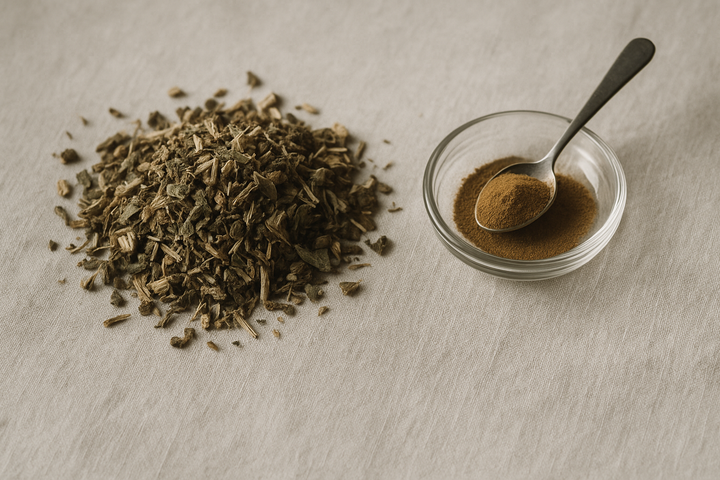
Shilajit (also known as mumijo or moomiyo) is a natural, tar-like resin found mainly in the Himalayas and other high mountain ranges. It forms over a very long period through the slow decomposition of plant and microbial material compressed in rock, and seeps out through cracks in warm weather. It has a long history of traditional use in Ayurveda. Today, it is usually sold as purified resin or powder.
What does it contain?
The two components discussed most often are fulvic acid and a broad mix of trace minerals. Scientific literature describes shilajit as a complex of humic substances in which fulvic acid and dibenzo-alpha-pyrones are the main organic components, alongside minerals [study]. Fulvic acid is usually used as the marker compound, and many products state a percentage of fulvic acid on the label.
The important, less widely advertised fact is that the amount of fulvic acid varies enormously between products. A 2024 independent ConsumerLab analysis of shilajit supplements found that the amount of fulvic acid per serving ranged from about 6.9 mg to more than 2,200 mg, a difference of more than a hundredfold between products. A stated percentage alone does not tell you the actual amount per dose, and methods for measuring fulvic acid differ.
Why quality and purity matter so much
Because shilajit forms in rock and concentrates whatever is present in its geological environment, it can also concentrate heavy metals such as lead, arsenic, cadmium and mercury. Independent analyses of raw shilajit and commercial supplements have confirmed that these elements may be present, and some studies also found less commonly tested contaminants such as thallium [study][study]. This is the single most important quality issue with shilajit, and it is why raw or untested resin is a genuine concern.
Reliable products are tested for heavy metals using ICP-MS (inductively coupled plasma mass spectrometry), a widely used method that detects contaminants at very low concentrations. In ConsumerLab's 2024 tests, the products examined contained lead, cadmium, arsenic and mercury below levels of concern at one serving per day. However, that result applied to the specific products tested, which is precisely why third-party testing of the product you buy matters.
How to choose good-quality shilajit
- Third-party heavy metal testing. Look for ICP-MS testing for lead, arsenic, cadmium and mercury, ideally with a certificate of analysis that you can actually view.
- A stated amount of fulvic acid, not just a percentage, along with clarity about how it was measured.
- Purified resin from a transparent supplier, with clear information about origin and batch.
- A brand that is easy to contact and publishes its test results.
For our own approach to sourcing, purification and testing, see our purified shilajit resin.
Is shilajit safe?
The main safety issue is contamination, not the resin itself: untested or poorly sourced shilajit may contain heavy metals, which is why laboratory testing is essential. In addition, do not use shilajit without medical advice if you are pregnant or breastfeeding, under 18, or have a relevant medical condition (including an iron-related condition, since shilajit contains minerals). If you take medication or have a health condition, speak to a doctor or pharmacist first. Supplements are not a substitute for medical care.
Shilajit and EU law
In the EU, shilajit is generally sold as a food supplement and must comply with food safety and quality rules, including limits for contaminants. Health claims on food supplements are strictly regulated by EU law, and there is no authorised EU health claim for shilajit. This is why this article, and any responsible brand, explains what shilajit is and how to assess its quality instead of promising what it will do for you. Its precise status may vary by country, so local rules apply.
Frequently asked questions
What is fulvic acid?
Fulvic acid is an organic compound formed during the decomposition of plant material. It is the compound most commonly used as a marker for shilajit and is what many labels measure.
Is more fulvic acid better?
Not necessarily, and a percentage on the label does not tell you the amount per dose. Independent testing has shown enormous differences between products, so a verified amount and clean heavy metal test results matter more than a large number on the front.
Does shilajit contain heavy metals?
It can, because it forms in rock. Good-quality products are tested using ICP-MS to confirm that lead, arsenic, cadmium and mercury remain within safe limits. Untested resin poses the real risk.
Resin or powder?
Both are available. What matters most is purification and third-party testing, not the format.
Does shilajit have an EU health claim?
No. There is no authorised EU health claim for shilajit, so we describe what it is and how to assess its quality, not what it does for you.
Sources
- Carrasco-Gallardo C, et al. Shilajit: a natural phytocomplex with potential procognitive activity. (background on fulvic acid and composition). PubMed 22482077
- Agarwal SP, et al. Review on shilajit used in traditional Indian medicine. J Ethnopharmacol. 2011 (composition: fulvic acid, dibenzo-alpha-pyrones, minerals). PubMed 21530631
- Rapid Determination and Quantification of Nutritional and Poisonous Metals in Shilajit Using Three Advanced Analytical Techniques (LIBS, ICP, EDX). 2021 (heavy metals, including Hg detection). PubMed 34800280
- Quantifying of thallium in Shilajit and its supplements to unveil the potential risk of consumption. 2025 (thallium in shilajit and supplements). PubMed 39827344
- ConsumerLab. Shilajit Supplements Review: fulvic acid amounts and heavy metals. 2024 (independent product testing; fulvic acid from 6.9 mg to 2,206 mg per serving). consumerlab.com
- European Commission. Novel Food status catalogue (entry for shilajit / mumijo). food.ec.europa.eu
- Regulation (EC) No 1924/2006 on nutrition and health claims made on foods (governs health claims on food supplements in the EU).
Written by the NOTFORTOMORROW editorial team. How we research: we base factual statements on independent testing, peer-reviewed research and official EU sources, cite our sources and date our reviews. This article is for educational purposes only and is not medical advice; it is not intended to diagnose, address, remedy or avert any disease. Speak to a qualified professional about your circumstances. Last reviewed: 2026-06-19.